March is one of the worst months to ignore your commercial property.
The summer heat has kept termite colonies active and expanding since October. Moisture from summer storms has softened timber in subfloors, wall cavities, and roof spaces. And right now – as temperatures start to ease into autumn – termites are at their most aggressive in foraging for new food sources.
If you own or manage a commercial building in Newcastle, the Hunter, Lake Macquarie, or the Central Coast, and you haven’t had a timber pest inspection in the last 12 months, this is worth your attention.
The Commercial Property Blind Spot
Most commercial landlords understand building maintenance in general terms – fix what’s broken, respond to tenant requests, keep the place presentable. Pest risk, though, tends to get treated as someone else’s problem. The tenant manages the business inside the building. The property manager handles routine issues. Surely termites would be noticed.
They usually aren’t. Not until the damage is in the advanced stages.
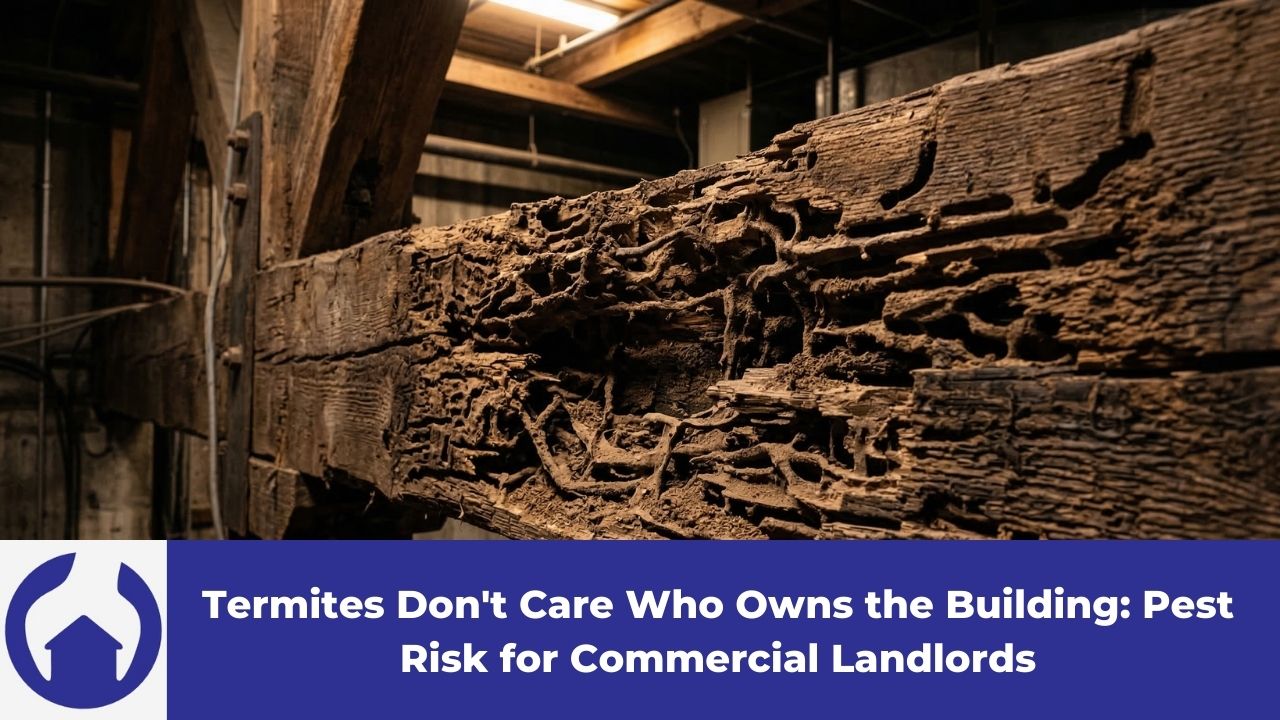
Termites don’t announce themselves. They work inside wall framing, beneath floor sheeting, within roof structures – anywhere there’s timber in contact with or close to moisture and soil. A building can have an active termite infestation for 12-24 months before any visible sign appears. By the time a tenant notices something – soft flooring, cracked internal sheeting, a door that suddenly won’t close properly – the structural framing behind it may already be compromised.
We’ve inspected commercial properties where significant termite damage was found in wall framing directly behind freshly painted internal walls. No visible sign from the tenant’s side. The damage was only found using thermal imaging, which detects the heat signatures of active termite workings and the moisture they create.
Why Commercial Buildings Aren’t Immune
There’s a common assumption that termites prefer older residential timber homes. They don’t discriminate.
Commercial buildings – warehouses, retail tenancies, offices, industrial sheds – often have features that make them attractive to termites. Concrete slab construction creates the warm, moisture-retaining conditions termites favour at ground level. Landscaping against external walls provides concealed pathways. Garden beds with retained moisture are among the most common termite entry points we find in commercial inspections.
Older commercial buildings with subfloors or timber framing are particularly exposed. Many commercial properties in Newcastle’s industrial areas and older CBDs were built 30-50 years ago with construction methods that would not pass current standards for termite management. Ant capping may be absent, inadequate, or deteriorated. Drainage may direct moisture toward the building rather than away from it.
High-traffic tenancies also create ongoing maintenance challenges. Retail and food businesses in particular generate humidity, condensation, and plumbing stress that over time creates the moisture conditions termites look for.
Your Duty of Care Doesn’t Stop at the Lease
Commercial landlords have obligations under NSW Work Health and Safety legislation and the common law duty of care to maintain premises in a condition that is safe for occupants and visitors. This includes structural integrity.
Termite damage that compromises framing, flooring, or load-bearing elements is a structural safety matter – not just a maintenance issue. If a floor fails or a structural element is weakened by pest damage, and it can be shown that no inspection program was in place, the exposure for the building owner is significant.
A documented annual timber pest inspection – conducted to AS 4349.3-2010 by a qualified and accredited inspector – demonstrates that you took reasonable steps to identify and manage pest risk. That paper trail matters.
It also matters commercially. An end-of-lease dispute where a tenant claims structural damage occurred during their tenancy is much easier to navigate when you have inspection records that predate and track the building’s condition over time. Without them, you’re arguing from memory.
What a Commercial Timber Pest Inspection Covers
A thorough commercial timber pest inspection isn’t a quick walk-through. Our inspectors assess all accessible areas of the building – subfloor where present, roof space, wall cavities where accessible, external perimeter including landscaping, drainage, and any timber-to-soil contact points.
Thermal imaging is part of every inspection we conduct. Active termite workings generate heat. Moisture ingress that creates termite-favourable conditions shows up on thermal camera before it’s visible to the eye. This isn’t optional technology for commercial properties – it’s the difference between finding an infestation early and discovering it after structural damage has occurred.
The report clearly distinguishes between active infestations, evidence of past activity, conducive conditions (things that increase risk), and recommendations for remediation or ongoing monitoring. It’s written in plain language with photographs, and our inspectors walk you through the findings.
How Often Should You Inspect?
AS 4349.3-2010 recommends timber pest inspections at least every 12 months. For commercial properties in higher-risk situations – bushland interfaces, older construction, coastal areas, buildings with known moisture issues – more frequently.
March is a practical time to schedule it. You’re catching the tail end of peak termite activity season, which means active infestations are easier to detect. You’re also getting ahead of the cooler months when activity slows, and any treatment or remediation work is easier to schedule without disrupting tenants.
Book a Commercial Inspection
CTP Pest and Building Inspections conducts commercial timber pest and building inspections across Newcastle, Lake Macquarie, Hunter Valley, Maitland, Port Stephens, and the Central Coast.
Our inspectors are licensed builders with a minimum of 25 years’ experience – not just qualified pest technicians. That building knowledge matters in a commercial inspection, where structural assessment and pest risk assessment overlap.
Reports are delivered the same day as the inspection. We’re available to discuss the findings directly with you or your property manager.
Call us on 0488 885 203, or get an Instant Quote or Order An Inspection today.