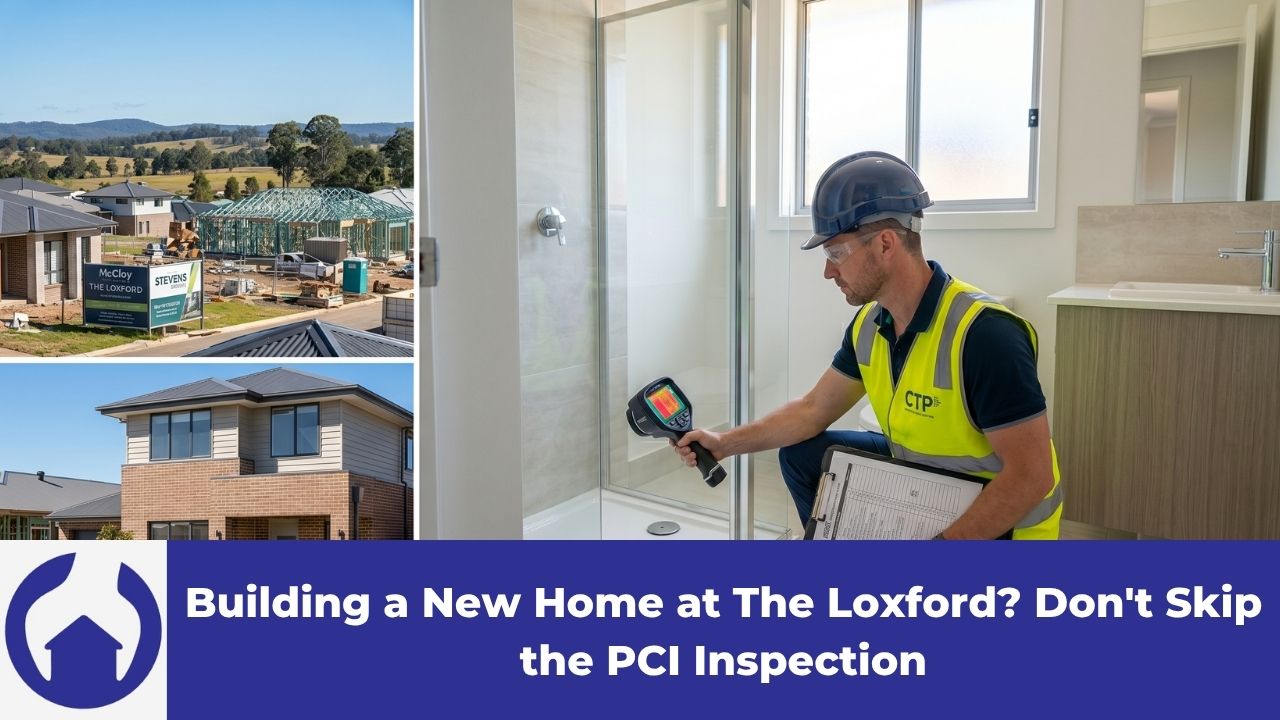
The Loxford at Gillieston Heights is one of the Hunter Valley’s most significant new residential releases. Developed by McCloy Group and Stevens Group on a 2,000 hectare site off Cessnock Road, it will eventually deliver around 2,000 homesites to the region – with blocks ranging from 450sqm to over 1,000sqm and a growing number of house and land packages available through volume builders including Montgomery Homes, Mojo Homes, and Eden Brae.
For buyers building new at The Loxford – or at any new land release across Maitland, Cessnock, and the Hunter – one inspection matters above all others before you hand over your final payment.
The Practical Completion Inspection. The PCI.
What a PCI Actually Is
A Practical Completion Inspection is an independent building inspection carried out when your builder advises that your new home is complete and ready for handover.
That’s the critical moment. Once you accept the keys and make your final payment, the leverage you have to get defects fixed shifts significantly. Builders are legally obligated to address defects identified before handover. After handover, you’re into warranty claim territory – which takes longer, requires more documentation, and doesn’t always go smoothly.
A PCI inspection conducted by a licensed, independent building inspector before you walk through with your builder for the handover meeting gives you a professional defect report to take into that meeting. Every item that isn’t right gets documented. You have written evidence. The builder addresses the defects before you settle, not after.
That’s the purpose of the PCI. It’s not about being difficult with your builder. It’s about protecting what is, for most people, the largest single financial commitment of their lives.
Learn more about our Practical Completion Inspections
Why New Builds Have Defects
This surprises some buyers. They assume a brand-new home, built to specification, shouldn’t have problems.
The reality of volume residential construction in new estates is that builds are managed across multiple sites simultaneously, with different trades cycling through on tight schedules. Subcontractors complete their portion of the work and move to the next job. Supervision across a large active estate like The Loxford where multiple homes are at various stages of construction at any given time is stretched.
The result is that defects in new builds are common. Not necessarily serious structural defects, though those do occur. More often it’s the accumulated list of items that weren’t finished properly, weren’t installed correctly, or don’t meet the specifications in your building contract.
Common defects found in PCI inspections on new Hunter Valley builds include:
- Cracking in plasterboard, cornices, and render beyond acceptable tolerances
- Waterproofing deficiencies in wet areas – shower bases, ensuite floors, laundry
- Incomplete or poorly finished paintwork, particularly around windows, doors, and architraves
- Drainage falls that don’t meet AS/NZS 3500 requirements – water pooling in showers or on paved areas
- Gaps, poorly sealed penetrations, or missing flashings in the roof and eaves
- Doors and windows that don’t operate correctly, lock properly, or seal against weather
- Concrete cracking in driveways, paths, and slabs beyond what the standard allows
- Missing or incorrectly installed insulation
- Electrical fittings, switches, or fixtures that aren’t operational or aren’t installed to specification
- Site drainage issues – ground levels, stormwater connections, swales
None of these are dramatic. But collectively, on a house worth $700,000 to $900,000-plus, they represent real money and real inconvenience if you’re trying to get them fixed after handover.
What the Inspector Does
Our PCI inspections at CTP are conducted by licensed builders with a minimum of 25 years’ construction experience. That matters in a new build inspection. Understanding what you’re looking at knowing what tolerances apply under AS 4349.1 (the Australian Standard for building inspections), what the building contract specifies, and what the National Construction Code requires, is the difference between a useful report and a superficial one.
The inspection covers the full building internally and externally, roof space, subfloor where present, garage, and all outdoor structures included in the build. Every defect is photographed and documented clearly in a written report delivered the same day as the inspection.
We use thermal imaging on every inspection as standard. On a new build this is particularly useful for identifying moisture in wet areas where waterproofing may have failed, and for identifying gaps in insulation installation that won’t be visible once walls are lined. These are the hidden defects that show up as problems, leaking showers, cold rooms, condensation issues after you’ve moved in and the builder considers the job done.
How the Process Works
1. Your builder notifies you of practical completion This is the trigger. Don’t book the handover meeting with your builder until your independent PCI inspection has been completed.
2. Book your PCI inspection immediately Contact us as soon as you receive the practical completion notice. We aim to complete the inspection within 48 hours of your booking and deliver the report on the same day.
3. Receive your report before the handover meeting The report documents every defect found, with photographs and clear descriptions. You take this report to the handover meeting with your builder.
4. Defects are addressed before final payment Your builder is obligated to rectify defects identified at practical completion before you make your final payment. Get a written schedule from your builder confirming what will be fixed and when.
5. Follow up if needed If defects are significant or numerous, we can conduct a follow-up inspection after rectification work is complete to confirm everything has been addressed properly.
The Loxford Specifically
Buyers at The Loxford are building in a fast-growing estate where construction activity across multiple stages is ongoing. The estate sits within the Maitland local government area, and builds are subject to NSW building legislation and the National Construction Code.
For house and land packages where the land purchase and the building contract are often managed together through the one builder the PCI is the primary opportunity buyers have to have the finished product independently assessed before the total purchase is complete. The builder has been managing the process. The PCI is where you bring in someone working entirely for you.
With blocks at The Loxford ranging from 450sqm to over 1,000sqm and home designs from multiple volume builders, every build is different. Site conditions, soil classification, drainage requirements, and specific contract inclusions all vary. A PCI by a licensed builder with genuine construction experience is not just an inspection qualification it will assess the building against what your contract specifies, not just a generic checklist.
Don’t Accept the Keys Until You’ve Had an Independent Inspection
The handover meeting with your builder is not the time to discover defects. By then you’re under time pressure, your builder is moving on to the next job, and the dynamic has shifted.
The PCI inspection completed before that meeting, with a written report in hand is the point where you have maximum leverage and the clearest contractual basis for getting things fixed.
If you’re building at The Loxford, at any new release in Maitland, Cessnock, Gillieston Heights, or anywhere across the Hunter Valley, book your PCI inspection with CTP before your handover date.
Call our team on 0488 885 203 to book in an inspection or alternatively, Order an Inspection or get An Instant Quote.