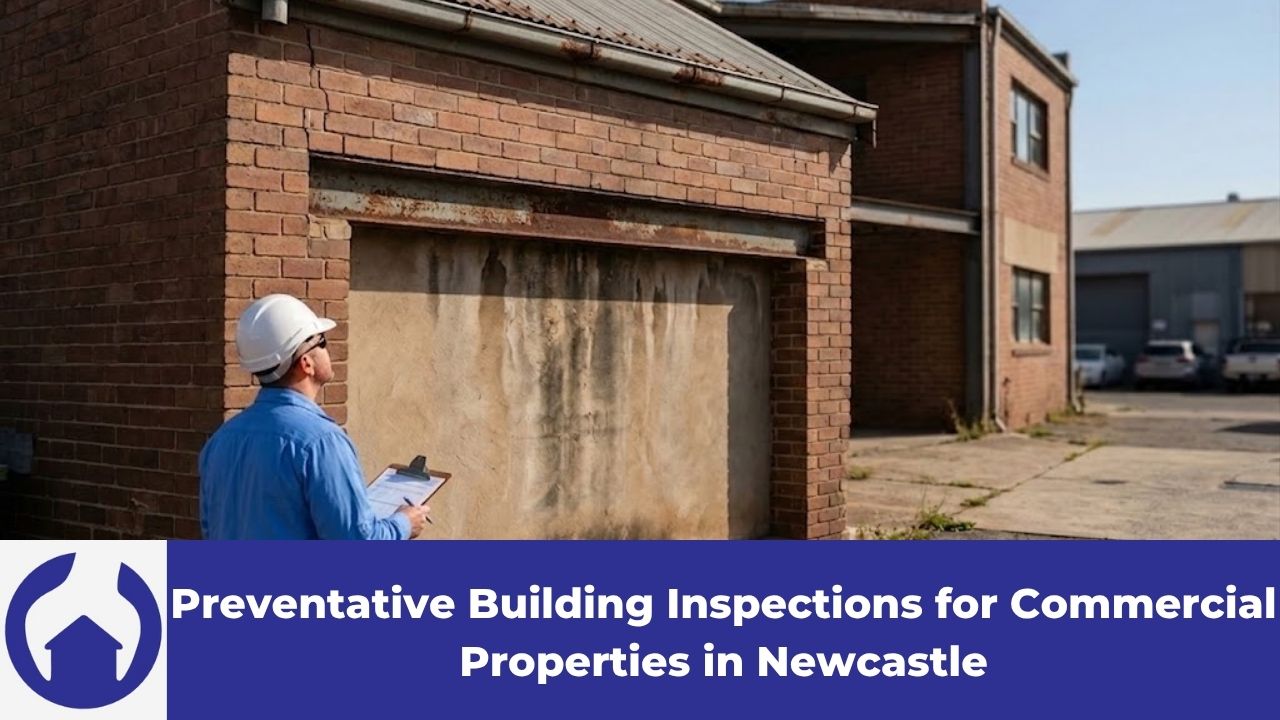
If you own a commercial building in Newcastle, there’s a good chance the only inspection it gets each year is the one that produces your Annual Fire Safety Statement. That statement is a legal requirement, and it matters. It also covers a narrow slice of the building.
The fire safety schedule lists the measures an accredited practitioner must assess. Exit lights, hydrants, alarms, sprinklers, fire doors. It says nothing about the roof, the slab, the drainage, the waterproofing, the facade or the timber. Those are the things that quietly cost owners six figures, and nothing in the legislation requires anyone to look at them.
A preventative commercial property inspection is what covers the rest. Here’s what it involves, when it’s worth doing, and why the fire statement in the foyer isn’t the reassurance most owners think it is.
The Inspection You’re Already Paying For
Under Part 12 of the Environmental Planning and Assessment (Development Certification and Fire Safety) Regulation 2021, the owner of a building with a fire safety schedule has to issue an Annual Fire Safety Statement every twelve months. It goes to the local council and to the Commissioner of Fire and Rescue NSW, and a copy has to be displayed prominently in the building alongside the current schedule.
Two details in that arrangement are worth understanding.
The first is scope. The statement deals with each essential fire safety measure specified in the schedule. That schedule varies building to building and it is a list of fire safety measures, not a list of building elements. Structural condition is not on it.
The second is what’s being declared. According to the NSW planning guidance, the owner is declaring that an accredited practitioner has assessed each measure as capable of performing to the standard in the schedule. The person making the declaration isn’t certifying how the measures perform. It’s a compliance document, and it does the job it was designed to do.
To be clear about our own position: CTP doesn’t issue Annual Fire Safety Statements. That work sits with an accredited practitioner in fire safety. What we do is the part nobody is legally required to arrange.
What Sits Outside the Schedule
Run through the failures that generate large invoices for commercial owners in the Hunter, and almost none of them involve fire equipment.
Box gutters and roof drainage that can’t cope with a heavy downpour, so water tracks into the ceiling space above a tenanted area. Failed waterproofing in a first-floor bathroom or a planter box. Concrete cancer in a car park slab or a balcony edge, where reinforcement rusts, expands and pushes the concrete off. Movement cracking through masonry from reactive clay or a leaking stormwater line. Termites in structural timbers of an older Wickham or Waratah building.
Every one of those starts small and cheap. Every one of them is visible to someone who knows where to look, well before it becomes a structural repair or a tenant claim.
None of them appear on a fire safety schedule.
Why Newcastle Buildings Fail the Way They Do
Local conditions do shape what we find. Newcastle’s commercial stock includes a lot of older brick and steel building, plenty of it within a few kilometres of salt air. Salt accelerates corrosion in reinforcement, lintels, roof sheeting and fixings, particularly where a building has been extended or reclad and dissimilar metals have ended up in contact.
The other factor is rainfall pattern. The Hunter gets long dry stretches broken by heavy falls. Drainage that copes for years will overflow in one event, and reactive soils that shrink through a dry spell then swell quickly can move footings enough to open up cracking that wasn’t there last winter.
That combination is why a building can look fine for a decade and then present several problems in the same year.
The Part That Matters If Something Goes Wrong
A commercial building is a workplace, and that brings duties with it. We’ve written separately about what the law expects of commercial landlords when a tenant or a visitor is injured, so we won’t repeat it here.
The point relevant to inspections is narrower. Where the question becomes whether an owner took reasonable steps, the difference between a defensible position and a difficult one is usually documentation. An owner who can produce dated reports showing the building was inspected, defects were identified and items were actioned in priority order is in a far stronger position than an owner who can produce a fire statement and nothing else.
That record only exists if someone made it.
What a Preventative Commercial Property Inspection Covers
A preventative commercial property inspection looks at the building as a whole: the roof exterior and roof space, the subfloor and under-building areas, interior and exterior of the structure, workshop and office spaces, car parking and concrete areas, boundary fencing, and the grounds within 30 metres of the building.
The pest component covers termites, borers and conditions that invite them, which for a commercial site often means poor subfloor ventilation, garden beds built up against walls, or stored timber and pallets against a boundary.
Thermal imaging is worth requesting alongside it. Moisture behind a wall lining or a hot spot in a roof space shows up on a thermal camera long before it stains a ceiling.
What comes back is an itemised list of defects with a priority order, which is the format that lets you budget rather than react.
How Often, and When
Once a year suits most commercial properties, and there’s a practical reason to run it near your fire statement date: you’re already thinking about the building, and you can hold the two records together.
Outside that cycle, there are four moments worth booking one.
Before a lease is signed or renewed, so the condition of the premises is documented, and both parties know what they’re taking on. Before you buy, which is the trigger most owners already understand. After a significant storm, because damage from a single event is far easier to attribute to that event when it’s documented promptly. And before major work starts next door, where a dilapidation report protects you if adjoining excavation moves your building.
Book a Commercial Inspection in Newcastle
We inspect commercial premises across Newcastle, Lake Macquarie, Maitland, Port Stephens and the Hunter Valley, from Broadmeadow and Adamstown through to Callaghan and the Upper Hunter.
If you want a straight assessment of what condition your building is in and what needs money spent on it first, call CTP on 0488 885 203 or Order an Inspection Online.