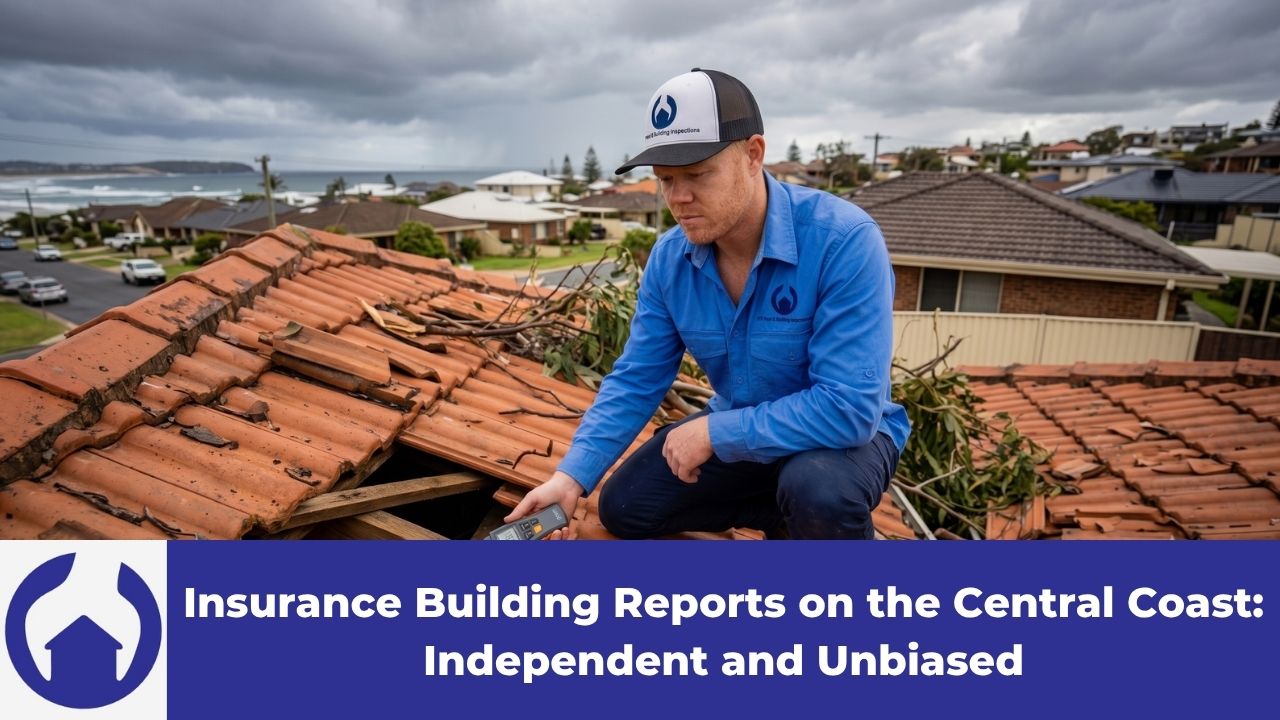
An insurance building report is an independent assessment of property damage, prepared by a licensed builder and written so it can stand up as evidence in a claim. On the Central Coast most of them follow storm damage, water getting in through a roof or wall, impact from a fallen tree, or cracking that has turned up after ground movement. People order their own report for one reason. The assessor who inspects your home for the insurer is engaged and paid by the insurer, and their findings are what the claim decision gets built on.
If you disagree with that decision, you need something to disagree with it using.
What an Insurance Building Report Covers
It’s not a standard pre-purchase report with a damage section bolted on. An insurance building report is built around the questions a claims officer has to answer.
- What is damaged, described item by item, with photographs.
- What caused it. This is the part that decides most claims.
- The line between structural damage and cosmetic damage.
- The scope of rectification work needed to put it right.
- Moisture readings and thermal imaging results where water is involved.
Causation is where a report earns its keep. Anyone can photograph a stained ceiling. Saying what put the water there and doing it with thermal imaging and moisture readings to back it up, takes someone who has built the thing they are looking at.
The Insurer’s Assessor Isn’t Working for You
That’s not an accusation of dishonesty. It’s how the engagement works. The loss adjuster or assessor is appointed by the insurer, briefed by the insurer, and reports to the insurer. They’re doing the job they were hired to do.
The Financial Rights Legal Centre puts it plainly in its factsheet on refused home claims: you may need your own expert evidence to argue against the insurer’s decision, and against the findings the insurer’s assessor or expert has made. Their guide to a refused home or contents claim is worth reading before you do anything else.
You’re also entitled to ask the insurer, in writing, for the reason the claim was cut back or knocked back, plus a copy of the evidence they relied on. That includes the assessor and expert reports. Get those first. You can’t argue against a report you haven’t read, and a good independent inspector will want to see it before writing anything.
Storm Damage or Wear and Tear
Most home policies exclude wear and tear, poor maintenance, faulty construction, and ground movement. So, the question that settles a lot of claims here isn’t the state of the roof. It’s what put it in that state. The storm, or the years before it.
The Financial Rights factsheet gives the textbook version. Rain enters a house during a storm. The insurer looks at the roof, finds cracked and missing tiles, and argues the water damage is far worse than it would have been on a properly maintained roof. If the wear was minor and made little difference to the extent of the damage, you should still be covered.
Answering that argument takes a builder. A report that helps you will state what the event damaged, comment on any signs of wear and tear it found and give a reasoned opinion on how much that wear changed the extent of the damage. Records of past maintenance and inspections sit alongside it well.
An inspector with no stake in the outcome is also free to tell you when the insurer has it right. That happens, and it saves people months of arguing a case they weren’t going to win.
What This Looks Like Across the Central Coast
The housing stock here pulls claims in a few predictable directions.
Older brick and fibro homes through Woy Woy, Umina, Ettalong, Toukley and The Entrance have had decades of salt air working on roof sheeting, gutters, flashings and fixings. When a big blow comes through, the argument about pre-existing condition follows almost automatically. Getting an inspector on site early, before the roof is patched, changes what can be proven later.
In the newer estates around Warnervale, Hamlyn Terrace and North Gosford, the disputes tend to be about slabs, cracking, drainage and stormwater. Ground movement is excluded under most policies, so the report needs to be clear about what moved, and why.
Around the bushland fringes and the older canopy suburbs, tree impact and branch strike claims are common. So is the follow-up argument about mould once the timber has been wet for a fortnight. Policies treat gradual damage differently to sudden damage, which is why a moisture reading on record in the first week is worth more than a photo taken a month later.
When to Get Your Own Report
Before the clean-up starts, if you possibly can. Once the evidence is cleared away it’s gone, and we’ve written separately about how to document building damage before you clean anything up.
- When the insurer’s scope of works looks thin against what you can see with your own eyes.
- When a claim is declined or reduced on causation grounds, such as wear and tear, gradual damage or lack of maintenance.
- Before you lodge an internal complaint, so the complaint arrives with evidence attached rather than a difference of opinion.
- For strata committees and landlords, where the cost of getting the scope wrong lands on owners rather than an insurer.
If the Claim Is Declined
There are two steps, and they run in that order.
First, complain in writing to the insurer’s internal dispute resolution team. Set out the issues clearly and attach your evidence. If they haven’t sorted it within 30 days, you can take it further.
Second, lodge a complaint with the Australian Financial Complaints Authority. AFCA is free and independent, and if AFCA decides the insurer has to pay your claim and you accept that decision, the insurer must pay it. Time limits apply, so don’t sit on it.
AFCA weighs the evidence from both sides. Insurers turn up with reports from engineers, hydrologists and loss adjusters. If nothing is put up against those reports, they stand unchallenged, and complaints get lost that way rather than on the merits. Free legal advice on insurance disputes is available from the Financial Rights Legal Centre’s Insurance Law Service on 1300 663 464.
Booking an Insurance Building Report on the Central Coast
Every CTP inspector is a licensed builder working under Builders Licence 260201C, registered with NSW Fair Trading, with a minimum of 25 years in the trade. Thermal imaging is included as standard, not charged as an extra. Reports are delivered the same day as the inspection, and your inspector will get on the phone and walk you through the findings, so you know what you are holding. Our building defect inspections on the Central Coast cover post-event damage assessment across every suburb in the region, from Gosford and Terrigal through to Wyong, Toukley and the Peninsula.
We’ve also written about why independent building inspections give more honest advice than builders or trades, which covers the same principle from the repair side.
Call the office on 0488 885 203 to book an insurance building report or use the Order an Inspection form. If you want a fixed price first, get anInstant Quote.